Educational Materials
Our educational materials library
The Pulmonary Fibrosis Foundation (PFF) is pleased to offer our educational materials to the pulmonary fibrosis (PF) community. As the trusted resource for the PF community, we are committed to providing disease education to the PF community, free of charge.
Our pulmonary fibrosis educational materials are available as downloadable PDF files below.
We've moved, and we're going digital!
Please note the PFF's new address is 223 W. Jackson Blvd., Suite 350, Chicago, IL 60606. Some PDFs have not been updated yet.
Further, we are proud to announce that our Educational Materials are being transferred into new desktop-and mobile friendly editions! The new editions will roll out over the span of the next few months. Be sure you're subscribed to our emails and following us on social media to be the first to know when new digital formats are ready. We look forward to re-introducing these resources to the pulmonary fibrosis community.
General Information
Our brochure introduces you to the Foundation and gives readers a glimpse of all the programs and services we offer to help those who have been affected by PF.
About the PFF brochureAs research about pulmonary fibrosis (PF) expands, many people living with PF are interested in reading about—and even participating in—clinical trials. Whether you’d like to be part of a study or just want to better understand what you’re reading about PF research, this guide helps explain common health research terms.
English
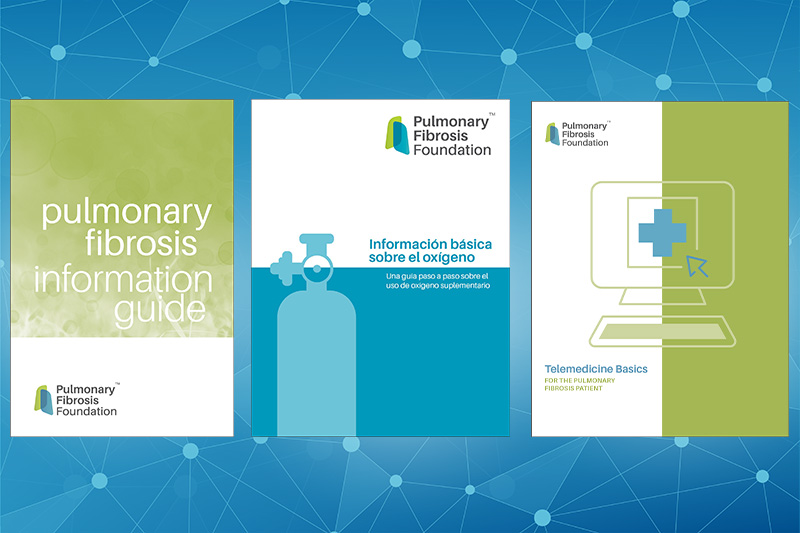
This guide gives patients, caregivers, and medical professionals comprehensive information about pulmonary fibrosis, treatment options, tips for monitoring your health, and ways to maintain your care. This guide is ideal for those who are newly diagnosed or wish to learn more about this disease. Please note that the information provided in this guide is specific to standard practices and resources available within the United States.
EnglishSpanish
French
Simplified Chinese
Hindi
Arabic
Portuguese
The PF Fact Sheet provides an overview of pulmonary fibrosis and statistics associated with this disease.
Pulmonary Fibrosis Quick FactsDoctors use a variety of strategies for monitoring patients’ pulmonary fibrosis. Along with symptoms, walking tests, and high-resolution computed tomography (HRCT) scans, pulmonary function tests (PFTs) are commonly used to determine if your disease is stable or changing. The following information is designed to help people living with PF understand what PFTs do and how to read a PFT report.
Use these small note cards to distribute to family and friends to help them understand what a diagnosis of pulmonary fibrosis means. Download the digital version to print at home, or order hard copies by calling the PFF Help Center.
Friends and Family Card (English)
Friends and Family Card Printable Version (English)
Friends and Family Card (Spanish)
Friends and Family Card Printable Version (Spanish)
Your Doctor and You
It’s common in healthcare environments to shorten the names of conditions, procedures, and equipment, using just the first letter of each word. All those letters can become confusing, so we created a quick reference guide for abbreviations and acronyms used in the diagnosis and treatment of interstitial lung disease and pulmonary fibrosis.
Newly diagnosed with pulmonary fibrosis? The Foundation has compiled a list of questions that you should ask your doctor during your office visit.
Questions for Your Doctor (English)Questions for Your Doctor (Spanish)
The Physician Notepad is a great tool to facilitate a conversation between a you and a healthcare professional. Each sheet has space available to customize information based on each individual’s diagnosis, treatment options, diagnostic tests, and follow-up appointments.
Physician Notepad (English)Physician Notepad (Spanish)
Telemedicine is the use of technology—smartphone, tablet, laptop, or desktop computer—to connect patients directly with their healthcare providers. In the Telemedicine Basics Booklet, patients will learn how to connect with a pulmonologist in a virtual format. Use the Telemedicine Basics Checklist to prepare for a successful visit.
Telemedicine Basics Booklet
English
Spanish
Hindi
Mandarin
Supplemental Oxygen
This booklet provides an in-depth overview of the the basics of supplemental oxygen, including equipment, getting started, Medicare information, and traveling.
Oxygen Basics Booklet (English)Oxygen Basics Booklet (Spanish)
The Pulmonary Fibrosis Foundation in partnership with the American Association for Respiratory Care (AARC) launched a quick start guide for supplemental oxygen at the American Thoracic Society (ATS) conference in May 2017. The new education resource is intended for people who have been newly prescribed supplemental oxygen and includes information about oxygen prescriptions, equipment operation, and how to use oxygen safely.
English / Printer-friendly versionSpanish / Printer-friendly version
Simplified Chinese / Printer-friendly version
Russian / Printer-friendly version
The Pulmonary Fibrosis Foundation launched a guide for traveling with supplemental oxygen. The new education resource is intended for people who have been newly prescribed supplemental oxygen and includes information about traveling on airplanes, as well as a checklist.
Traveling With Supplemental Oxygen (English)Traveling With Supplemental Oxygen Printable Version (English)
Traveling With Supplemental Oxygen (Spanish)
This booklet provides an in-depth overview of your rights when it comes to supplemental oxygen. This list of rights is for patients who have original Medicare. If you have a Medicare Advantage plan, your plan will cover oxygen but there may be differences in how they cover oxygen. Contact your plan for more information.
Medicare Patients’ Oxygen Rights (English)Medicare Patients’ Oxygen Rights (Spanish)
Treatment Options
Participating in Clinical Trials: A Guide for Patients with Pulmonary Fibrosis
Participating in Clinical Trials: A Guide for Patients with Pulmonary Fibrosis (Spanish)
After your lung transplant—major surgery for which you prepared carefully—you’ll likely enjoy a significantly improved quality of life. Most patients who have a transplant due to the effects of pulmonary fibrosis breathe better, increase their activity, and can discontinue supplemental oxygen. Some people continue to work and travel.
But even when surgery results are positive, life after a transplant has its own challenges. To maintain the best possible health and reduce the chance of complications, you’ll need to carefully follow your care team’s instructions throughout your life. This booklet provides an overview of what to expect.
Life After Lung Transplant (English)
Life After Lung Transplant (Spanish)Lung transplant—surgery to remove a damaged or diseased lung and replace it with a healthy lung from a deceased donor—is a life-saving treatment for people with late-stage lung disease after other treatments have been exhausted. Studies demonstrate that lung transplantation is associated with a significant improvement in quality of life.
Learning about and preparing for lung transplant can be an overwhelming process. This booklet is designed to help PF patients considering lung transplant learn what’s involved and how to get started. Referral and transplantation criteria can vary by transplant center.
Preparing for a Lung Transplant (Spanish)
Palliative care is a great option to consider if you’re living with pulmonary fibrosis and struggling to manage your symptoms. While it does not treat the disease, palliative care focuses instead on treating your symptoms. Through palliative care, you can find relief for persistent cough, shortness of breath, fatigue, depression and anxiety, and much more. To learn more about palliative care, the services that palliative care provides, and how to request for this service download our newest material now at pulmonaryfibrosis.org/education
Symptom Management for PF: How Palliative Care Can Improve Quality of Life (English)
Symptom Management for PF: How Palliative Care Can Improve Quality of Life (Spanish)
People with IPF and PF can experience increasing shortness of breath and cough. These symptoms may lead to a progressive decline in physical activities and social isolation, and worsening breathlessness, fatigue, and mood disorders including depression and anxiety.
Pulmonary rehabilitation (PR) has been found to improve physical function, breathlessness (dyspnea), mood and quality of life in people with IPF and other types of pulmonary fibrosis (PF).
For Healthcare Professionals
The ILD Nursing and Allied Health Guide is a comprehensive resource to help health care professionals learn more about disease identification, interpreting test results, comorbidities, disease management, and advising and supporting patients with pulmonary fibrosis.
The Rheumatology Pocket Guide is an educational tool for rheumatologists to help familiarize them with signs of interstitial lung disease in patients with connective tissue disease. The guide contains information about symptoms, prevalence, risk factors, and common HRCT patterns in connective tissue disease-related interstitial lung disease (CTD-ILD), as well as an emphasis on the importance of multidisciplinary discussion for patients suspected to have CTD-ILD.
Our guide for physicians can be displayed in waiting rooms, offices, or exam rooms to provide a visual overview of pulmonary fibrosis.
The Pulmonary Rehabilitation Pocket Guide is an educational tool for allied health professionals who work in a pulmonary rehabilitation environment. This pocket guide highlights the differences between pulmonary fibrosis and other forms of chronic lung diseases and offers useful information about pulmonary rehabilitation, physical activity, supplemental oxygen, and disease management for patients with pulmonary fibrosis.
Need help?
If you need help or have questions about any of our materials, please contact the PFF Help Center at 844.TalkPFF or help@pulmonaryfibrosis.org.